

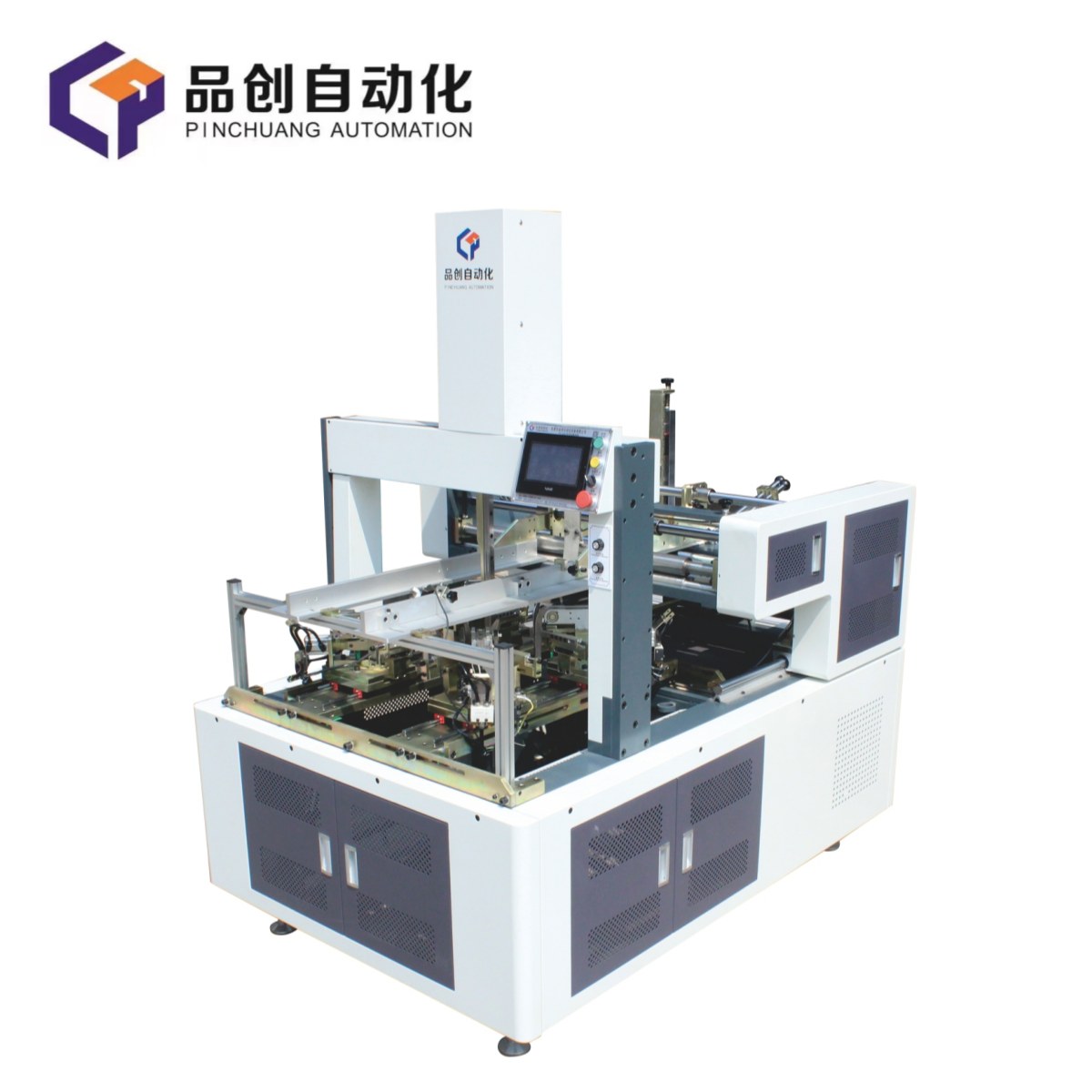
An automatic corner pasting machine applies a strip of paper tape to each of the four corner flaps of a rigid box and presses it flat. That tape is what holds the box square under load — without it, a wrapped box relies on the wrap alone, and the wrap will separate at the corner the first time the box is handled roughly. Corners fail before panels do, which makes this one of the least glamorous and most important stations in a rigid box line.
At Pinchuang, we have been manufacturing rigid box equipment in Dongguan since 2008, and corner pasting is the station buyers most often treat as an afterthought until it starts costing them returns. This guide explains why corners fail first, what the tape is actually doing, how the three machine classes differ, and the three checks that tell you whether a corner will survive a shipment.
Why Corners Fail First, and What an Automatic Corner Pasting Machine Changes
A rigid box is a box with no folding structure holding it together. The wrap is bonded to the board face, and at the corner the wrap has to make a 90-degree turn and fold over itself. That fold is the weakest point in the whole product, and it is the point that takes the most abuse: corners are where a box is gripped, stacked, dropped and slid across a shelf.
On a bench, corner tape is applied by hand. The result depends on the operator's consistency, and consistency is exactly what a corner needs. A tape strip applied 2 mm deeper on one corner than the other will produce a box that opens unevenly weeks later, in a warehouse the operator will never see.
An automatic corner pasting machine changes three things. It applies tape to all four corners with the same geometry, it presses the tape so it bonds immediately rather than waiting for glue to cure under its own weight, and it counts output, so a missing corner is detectable rather than silent.
What it does not change is the fold itself. If the V-grooving upstream is cutting uneven channels, the corners will still be uneven, and tape will only slow the failure down.
What Corner Pasting Actually Does, and Why Tape Geometry Matters
Corner pasting is a reinforcement operation, not a cosmetic one. The tape bridges the gap between the two flaps that meet at the corner, so that load applied to the box wall is transferred through the tape instead of through the wrap alone.
Two geometry settings decide whether it works.
- Tape width and depth. The strip has to cover enough of both flaps to carry the load, but not so much that it wraps onto the visible face of the box. On our machines tape width runs from 10 mm to 80 mm, and that range has to be matched to the box height rather than left at a default.
- Alignment to the fold. The tape should sit symmetrically across the corner fold line. Tape that is offset will make one flap stiff and the other weak, and the box will tend to lean when stacked.
This is also where the upstream stations show up. Corner tape needs a flat, well-folded flap to bond to; if the board was not grooved cleanly, the flap will be curved, and tape on a curved flap only holds one edge. A paper gluing machine that applied an uneven film to the wrap has the same effect, because the wrap is what the tape is pressed against on the outer face.
Three Classes of Corner Pasting Machine
The three configurations on our platform are aimed at three different points on the volume curve. The table sets out what differs.
| Model | PC-40 | PC-500B | PC-500A |
|---|---|---|---|
| Automation level | Manual-assist | Automatic, board stacking | High-speed automatic |
| Production speed | 20–40 pcs/min | 25–40 pcs/min | 40–70 pcs/min |
| Smallest box | 40 × 40 × 10 mm | 80 × 60 × 15 mm | 45 × 45 × 10 mm |
| Machine weight | 200 kg | 1100 kg | 960 kg |
| Best fit for | Small boxes and short runs | Steady mid-volume production | Volume lines and larger boards |
The smallest-box figure is the one that disqualifies machines most often. If your range includes a 45 mm jewellery box, PC-500B is ruled out at the small end, and the choice is between the PC-40 and the PC-500A. Get your smallest size on the table before you look at throughput.
Three Corner Quality Checks
You can audit corner pasting without any instruments. Three checks cover almost every failure mode.
1. The press test
Stand the box on a table and press down on two opposite corners. A correctly pasted corner will resist without the walls splaying outward. If the box flexes and stays flexed, the tape is too narrow or too shallow for the load it is expected to carry.
2. The visual check
Look at the corner from the outside. Tape should not be visible on the finished face of the box. If it is, the tape is too wide or has been applied too far around the fold, and the box will fail a retail inspection even though it is structurally sound.
3. The repeatability check
Take four boxes from different points in a run and compare their corners against each other rather than against a sample. Corner pasting is a repeatability problem, not a precision problem — a machine that produces four identical corners at a slightly wrong depth is easier to correct than a machine that produces four different ones.
If a corner fails, the useful question is whether the fault is in the tape, the fold or the board. Tape depth is a machine setting; a curved flap is a grooving problem; a corner that cracks instead of folding is a board-thickness issue. Adjusting the corner pasting machine when the real problem is upstream is the most common waste of time we see on a line.
Where Corner Pasting Sits in the Line
Corner pasting sits between V-grooving and forming. It receives a grooved, glued and wrapped panel and hands a reinforced flat panel to the rigid box forming machine, which turns it into a three-dimensional box. In a production line the three stations should be matched, which is why a corner pasting machine rated at 70 pcs/min behind a forming station rated at 19 pcs/min is a capacity you will never use.
For scale reference, Pinchuang builds this equipment in a 10,000 m² facility in Dongguan with more than 100 employees, and the machines ship to over 30 countries. We have been manufacturing rigid box equipment since 2008, and we exhibit at All in Print China, Printing South China, China Print, Drupa, SINO FOLDING CARTON and WEPACK.


Corner reinforcement matters most for the boxes that get handled hardest — jewellery, watches and gift sets. Looking at the applications we see most often is a useful way to judge how much corner strength your own market actually demands.
Common Questions About Corner Pasting
Is corner pasting always necessary on a rigid box?
For any box that will be stacked, shipped or handled more than once, yes. Very small display boxes that never leave a shelf can sometimes survive without tape, but the reduction in strength is significant and we would not recommend it for export packaging.
How deep should the corner tape go?
Deep enough to bridge both flaps and carry the load, shallow enough that it never shows on the finished face. The right setting is a function of box height, which is why tape width on our machines is adjustable from 10 mm to 80 mm rather than fixed. Set it with a finished sample box in hand, not from a table.
Can corner pasting be added to an existing line later?
Yes, and it is one of the most common upgrades we ship. If corners are the current quality complaint, adding a corner pasting station to an existing wrap and forming setup is far cheaper than replacing the line. The only condition is that the new station's speed and box range have to be matched to what is already on the floor.
Why do corners open after a few weeks in storage?
Usually moisture rather than tape. A box left in a humid warehouse will absorb water through the wrap and the board, the board will swell slightly, and the corner joint will be the first place that shows the movement. Tape depth and glue film both affect how much tolerance the corner has, but storage conditions decide whether the problem appears at all.
Send Pinchuang a box with a corner you are not happy with, along with your box height and board thickness. We will tell you which automatic corner pasting machine setting your product needs, and whether the fault starts further up the line.
Send us a corner sample Compare all corner pasting models